

Bills of Materials in construction are working lists of the materials required for a project. When structured properly, they support estimating, procurement, scope review, and cost control. A useful BOM is not just a list of parts—it helps reduce omissions, track revisions, and improve pricing accuracy.
In construction, a Bill of Materials is more than a list of items. It is one of the documents that connects scope, pricing, purchasing, and execution. When a BOM is incomplete or poorly organized, the result is often missed materials, unclear pricing, avoidable delays, and last-minute confusion during tendering or buyout.
Well-structured Bills of Materials in Construction do not eliminate all risk, but they can significantly improve clarity and consistency across the early stages of any project.
What a Bill of Materials Is
A Bill of Materials (BOM) is a structured list of the materials, components, and quantities required for a project or a defined portion of work. In construction, it is commonly used during estimating, budgeting, procurement, and early project planning.
Depending on the trade and stage of the job, a BOM may range from a preliminary list used for pricing to a detailed working document that supports purchasing and execution.
Why It Matters in Construction
A clear BOM improves more than organization. It helps estimators review scope more effectively, supports more accurate pricing, and provides a cleaner handoff into procurement.
When used properly, it can:
- Reduce the risk of missed materials
- Improve consistency across estimates
- Support vendor pricing and comparisons
- Provide a reference point for revisions and changes
In short, it helps move a project from assumption to structure.
Where BOMs Go Wrong on Real Projects
In practice, Bills of Materials often fail for predictable reasons.
Quantities may be incomplete or based on early assumptions that were never updated. Scope may not be clearly defined, leading to gaps between what was priced and what is required. Pricing may be gathered against one version of drawings while revisions continue in the background. Substitutions or alternates may be discussed but never properly captured.
In some cases, the BOM becomes a static list when it should be treated as a working document. When this happens, errors compound across estimating, purchasing, and execution.
These issues are rarely caused by lack of effort—they are usually the result of structure, or the lack of it.
What a Functional BOM Should Include
A functional Bill of Materials should do more than list products. It should support the way a project is actually priced and delivered.
At a minimum, a BOM should:
- Clearly organize materials and quantities
- Separate scope where required (by area, system, or phase)
- Support pricing and vendor comparison
- Allow for notes, assumptions, and exclusions
- Make it easy to track revisions or updates
As projects become more complex, the BOM should evolve with them. It should remain usable beyond the initial takeoff and continue to support procurement and execution decisions.
Common Tools Used to Build a BOM
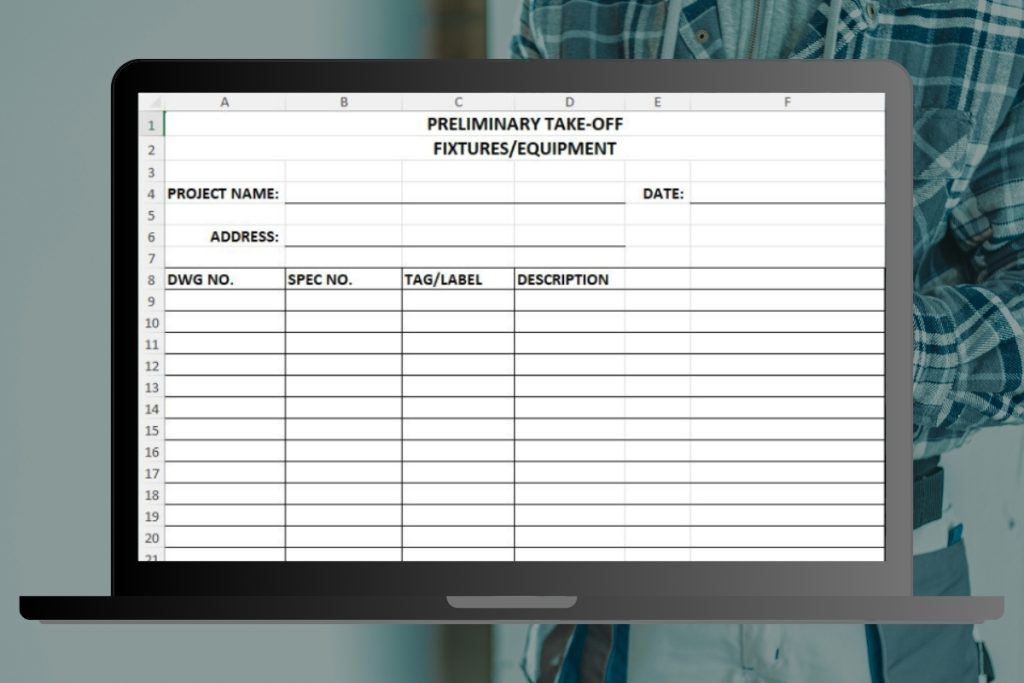
Bills of Materials in Construction are often created using spreadsheet-based tools such as Microsoft Excel or Google Sheets due to their flexibility and ease of use.
For some teams, a simple spreadsheet is sufficient. For others, a more structured format improves consistency and reduces setup time. Templates can help standardize how information is organized, making it easier to move from estimating into purchasing without reworking the data.
The most effective approach is the one that keeps the information clear, consistent, and easy to update as the project evolves.
In Practice
A strong BOM is not built once and forgotten. It is reviewed, adjusted, and refined as more information becomes available.
Even a simple improvement in structure—such as separating material groups clearly or documenting assumptions—can prevent issues later in the process. Over time, consistent formatting and organization can significantly reduce rework and improve overall efficiency.
In construction, a Bill of Materials is most valuable when it functions as a working document rather than a checklist. The clearer the structure, the easier it is to price, review, revise, and purchase with confidence.
A well-built BOM does not just support the estimate—it supports the entire project lifecycle.